-->
No
No.
6/Travel/slider
Showing posts with label Michelangelo. Show all posts

Florence: A Renaissance Splendour

No comments
Florence is the Capital of Tuscany and also of Italian Renaissance. It was the home base of the Wealthy and Aristocratic Medici Family who supported and financed the Great Florentine Artist, Michelangelo Buonarotti.  All around Florence, the City still pays homage to the Medici Family and Michelangelo.

We arrived in Florence via the Tren Italia Speed Train. From Rome to Florence, it was only a One and a half hour trip. We spent the whole day in Florence to just walk around, visit some sights, eat more Italian Pasta and to shop!  Here is our Walking Tour of Florence...

The Duomo.
We decided to walk around Florence instead of joining the Tour. Our first stop was The Duomo which was just a short walk from the Train Station. Along the way to The Duomo, we stopped by some Shoes Stores.. Leather is abundant in the Florence.

The Gates of Paradise in the Baptistery depicts the Old Testament in the panels. The Baptistery is located right in front of The Duomo.

Loggia Dei Lanzi.
From The Duomo, we walked to the beautiful Piazza Della Signorina where we found the Loggia Dei Lanzi. On display are the replica sculptures of Renaissance Florentine Artists.

The most famous Sculpture is Perseus (1553) by Cellini's. Perseus was the Greek hero who killed Medusa. Here we see Perseus holding the head of Medusa.


Then right beside the Loggia Dei Lanzi is the Palazzo Vecchio. This building was built in 1294 but completed with modifications in 1592. This building is now used for Government functions. It is open for visitors. The Palazzo is worth visiting as there are many Art and Sculptures inside. Outside the Palazzo is the Neptune Fountain, the replica of Michelangelo's David and the replica statue of Hercules and Cacus

The Entrance Courtyard inside the Palazzo Vecchio. The Entrance to the Palazzo is Grand! "This is called the Michelozzo's Court, with gilded stucco columns and frescoes by Vasari, and with Verrocchio's Fountain with a Winged Putto holding a Fish in the center. "

We walked around the Palazzo admiring all of the beautiful interiors, more Art with huge paintings and numerous Sculptures. We were just amazed with all of these art in Florence!  We have not even visited the Museums!

Entrance to the Palazzo with the view of the replica of Michelangelo's David. The original statue of David is in the Galleria Dell'Accademia. Visitors are required to obtain tickets in advance and by reservation.

On the Left picture is the replica Sculpture of Hercules and Cacus. On the Right picture is the replica statue of Donatello's Judith. The original sculpture of Donatello's Judith is on display inside the Palazzo.

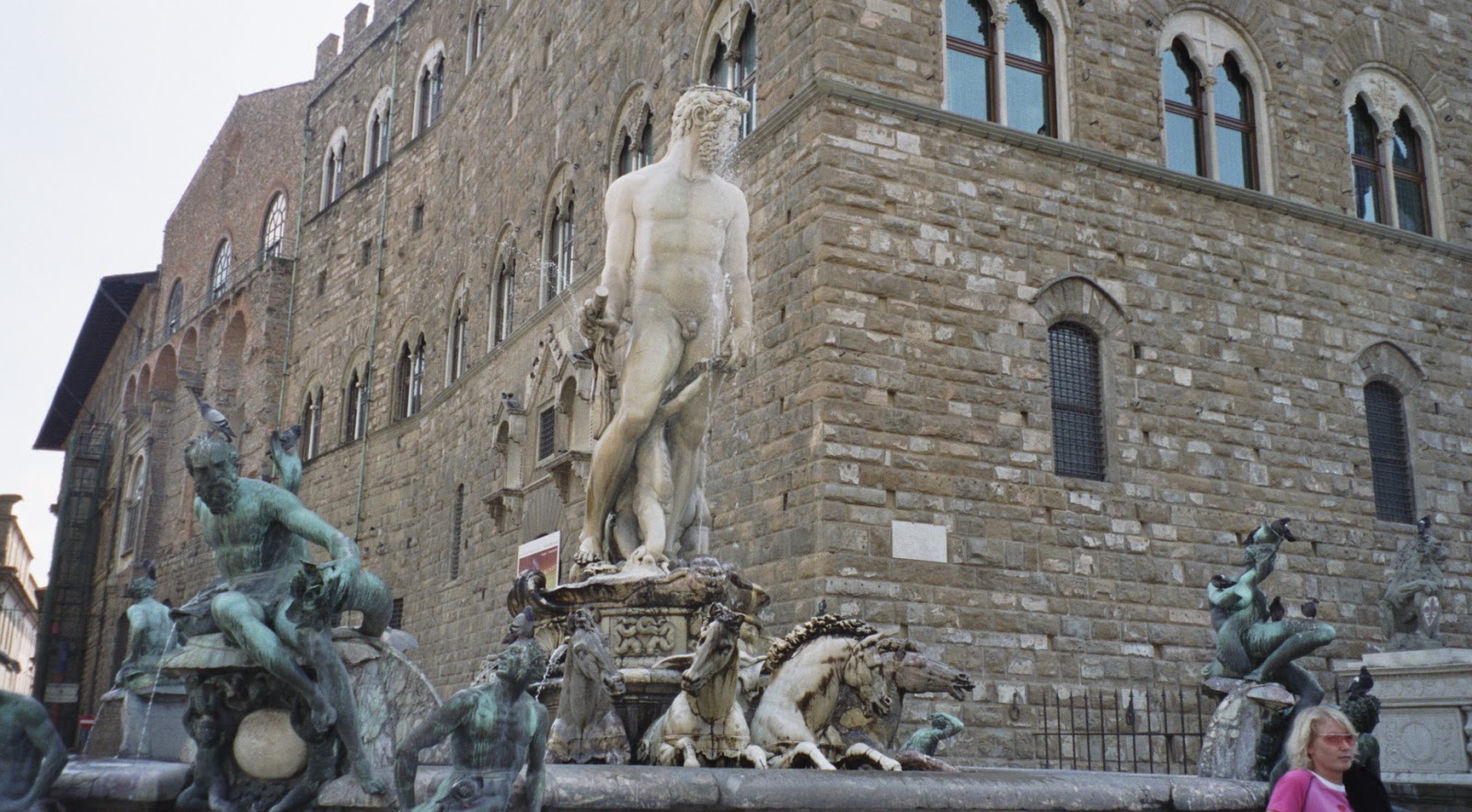
Neptune's Fountain. by Bartolomeo Ammannati (1563-1575). 
"Because of the enormous white mass of the Sea God set in the center of the fountain on a chariot drawn by sea horses, the Florentines renamed the sculpture Il Biancone,  the White Giant."

The Uffizi Gallery is the most famous Picture Gallery in Italy. It is well known in the world as one of the best Museum that features various schools of Italian and European paintings.
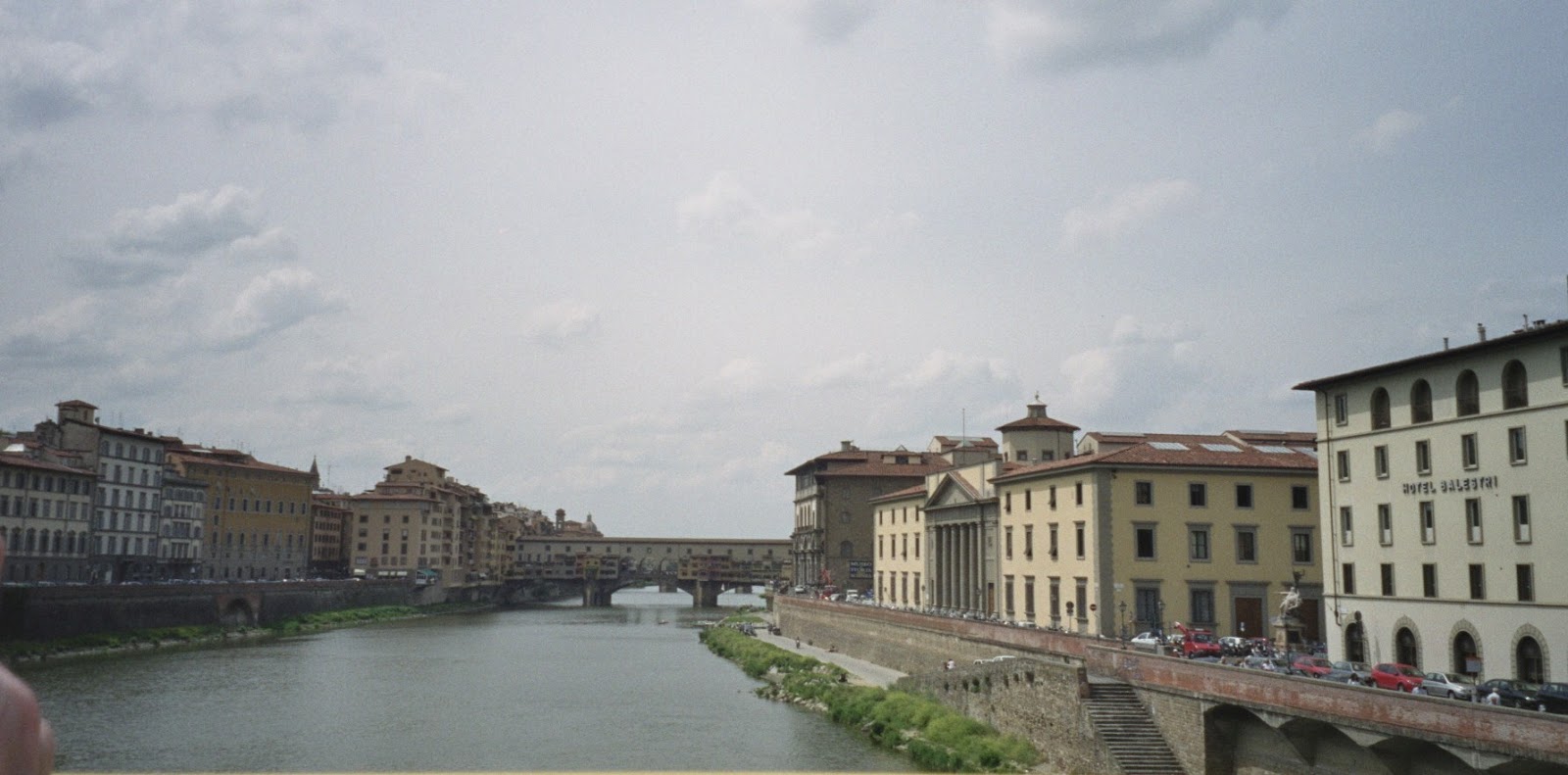
View of the Arno River in Florence. From the Uffizi Gallery, we walked along the Arno River to view the surrounding city and the view of the Ponte Vecchio. This view reminds me of one of the scenes in the famous movie "A Room With A View" starring Helena Bonham Carter and set in Florence. Try to watch the movie. It is  a great movie with a great setting. It might inspire you to visit Florence.

Ponte Vecchio.
"The Ponte Vecchio is the oldest bridge in Florence. It was built by Neri Di Fioravante (1345), a solid but elegant structure with three arches. It is characterized by the small houses that line both sides of the bridge."  The Bridge is now filed with sidewalk shops of Florentine souvenirs and jewelleries.
View of the Arno River.

More view of the Arno River and the beautiful City of Florence. That is me and my Mom.

Church of Santa Croce.
After walking along the Arno River, we passed by the Santa Croce Church. There are shops along the Piazza di Santa Croce.

Interior Stained Glass Window and ornate walls of the Church.

The Cross at Santa Croce.


On the Left Picture is the Burial place  of  Galileo. On the Right Picture is the Burial place of Michelangelo.  The Church of Santa Croce is full of Burial places of Great Italians.

Burial  Place of Machiavelli.


Art students relaxing and drawing at Piazza di Santa Croce. Notice the abundant stalls selling Florentine Leather bags. Merchants sell leather jackets, bags and accessories in the surrounding buildings.


Best of all, after all that walking around, we had Gelato for refreshment.


Florence is a walking city. We just spent a day, walking around, going sightseeing, observing all of  the abundant Masterpieces all around  the City, going shopping for their beautiful leather products, had a Salad and Pizza lunch in one of the Restaurants overlooking the Piazza Della Signorina and  had some Gelato for refreshments at Piazza  Di Santa Croce. From Santa Croce, we walked all the way back to the Train Station, passing by the shops and some more sights along the way. Then we reached the Train Station to go back to Rome. It was a day well spent.


Reference: The Golden Book of Florence,All of the City and its Masterpieces.

Vatican Museum and The Sistine Chapel

1 comment


Inside the Vatican Museum.


Elaborate ceilings in the Vatican Museum.


I just have this fascination of taking photographs of beautiful ceilings. These ceilings have the 3D effect as explained by our Guide.  All  along the Vatican Museum, I can't help looking up in the ornate ceilings, room after room in the Museum. It's like always looking up to God!


The Vatican Collection of Marble statues and sculptures. The Collection in the Vatican could rival the Louvre Museum, maybe even more. There are many items stored in the Vatican Archives that cannot be shared or be seen by the rest of Mankind.


The Vatican Gardens which was designed by Donato Bramante. All of these - the Gardens, the Museum and the Sistine Chapel are all part of the Vatican Museum tour. Visitors can also eat in the Vatican Canteen where they have this delicious Pizza! Right at the Vatican! It is better to have lunch in there because  it will at least take the full day to see the Vatican Museum, Sistine Chapel and St. Peter's Basilica.


Inside The Sistine Chapel

 Photography is not allowed inside The Sistine Chapel. It is always crowded and quite noisy. I suggest that you find your little nook in The Sistine Chapel to sit down and marvel at this Great work of Art created by Michelangelo and Raphael for Man. Also, The Sistine Chapel is known as the place "Where the Holy Spirit Acts.  It is there that the Holy Spirit has illuminated the cardinals, guiding them in their election of a new pontiff."


The Sistine Chapel Ceiling  as  painted  by Michelangelo showing the creation of Man from the Genesis chapter of the Bible. 


The Ceiling and the Last Judgement in the Main altar were designed and painted by Michelangelo. The murals on the left and right side of the Sistine Chapel were painted by Raphael. The Sistine Chapel is the most beautiful Chapel in the World.


 The Creation of Man. God giving life to Man as painted by Michelangelo.


The temptation of Adam and Eve as painted by Michelangelo.


The Last Judgement as painted by Michelangelo.


For me, Michelangelo is the greatest Artist of all. I believe that he was guided, inspired and empowered by God to create all of these beautiful and majestic art depicting God's Creation and up to His Last Judgement of Mankind. It is God's way of showing Man  how much He loves us. It is the story of God and Man. No other Museum can show this Great Love Story but in the Vatican Museum and The Sistine Chapel.


Source: Vatican City, Edizioni Musei Vaticani.


Rome: Imperial Splendour

No comments
The Splendour of Imperial Rome can be seen in the Architecture of the Monuments, the Fountains and Buildings around Rome.  The style is mostly Baroque, with lots of ornate trimmings and decorations in the Buildings. It is completely different from the Architecture of Ancient Rome. Baroque style is more romantic, expressive kind of art, mostly built using  marble which is abundant around Italy.  After the Caesars ruled Rome, the Emperors and then Kings of Italy continued building on the Imperial Splendour of Rome.

Fontana Di Trevi
The Fontana Di Trevi is the largest Baroque Fountain in Rome. It was initially built by Nicola Salvi in 1732 but completed by another artist, Giuseppe Pannini in 1762.  The Centre Statue is the God Oceanus while the two female statues are  Abundance spills water from her urn and Salubrity holds a cup from which a snake drinks.

Traditional legend is that if visitors throw a coin into the fountain ensures their return to Rome. There are several movies that was featured in this fountain. The most famous were the Classics 1954s Three Coins in a Fountain and famous Italian Director Federico Fellini's movie La Dolce Vita.

The crowd around the Fontana Di Trevi.


Vittorio Emmanuel II  Monument

The National Monument of Vittorio Emmanuel II was built in honour of the First King of the United Italy.


"The monument was designed by Giuseppe Sacconi in 1885; sculpture for it was parceled out to established sculptors all over Italy, such as Angelo Zanelli. It was inaugurated in 1911 and completed in 1935.
The monument is built of white marble from Botticino, Brescia, and features stairways, Corinthian Columns, fountains, an equestrian sculpture of Victor Emmanuel and two statues of the goddess Victoria riding on quadrigas. The structure is 135 m (443 ft) wide and 70 m (230 ft) high. If the quadrigae and winged victories are included, the height is to 81 m (266 ft).
The base of the structure houses the museum of Italian Reunification. In 2007, a panoramic elevator was added to the structure, allowing visitors to ride up to the roof for 360 degree views of Rome."


The Monument also include the Tomb of the Unknown Soldier with an Eternal Flame.

View of the huge Monument seen from the distance. Also views of Imperial Rome buildings.

Piazza Venezia
Piazza Venezia is located right in front of the Vittorio Emmanuel II Monument. The Piazza takes its name from Cardinal Venezia who built the nearby Palazzo Venezia which was a former Embassy of the city of the Republic of Venice (before Italy's Unification).

Palazzo Barberini
Entrance Gate to the Palazzo Barberini - Galleria Nazionale D'Arte Antica.

All around Rome, there are many Palaces that belong to the Aristocratic families of Rome. One of them is the Palazzo Barberini, a Baroque Palace, which is now a Museum called Galleria Nazionale D'Arte Antica. The Museum houses some paintings of Raphael and Caravaggio.

Piazza Barberini

The Piazza Barberini was named after the Baroque Palace nearby, Palazzo Barberini. The Triton Fountain was also Baroque in style and was sculpted by Bernini. Behind the Piazza is the famous street in Rome, Via Veneto with its high end shops and Restaurants.


Piazza Della Repubblica
In Piazza Della Repubblica there is a grand fountain in the middle which has 4 statues of Naiads.
"The naiads represented are the Nymph of the Lakes (recognisable by the swan she holds), the Nymph of the Rivers (stretched out on a monster of the rivers), the Nymph of the Oceans (riding a horse symbolising of the sea), and the Nymph of the Underground Waters (leaning over a mysterious dragon). In the centre is Rutelli's Glauco group (1911/12), symbolizing the dominion of the man over natural force and replacing a previous sculpture."


View of the Tiber River in Rome.


Beautiful and grand bridges crossing the Tiber River.


Campidoglio
The Campidoglio was the former Citadel or camp of the early Romans. But during the Renaissance period, this whole Piazza with the surrounding Palaces were designed by the Great Artist Michelangelo Buonarroti from 1536 to 1546. This was the first Urban design of a "Capitol" city. Michelangelo designed this whole area facing the Vatican City and turning its back from the Roman Forum which was the Centre of Government during Caesar's time.
Photo Credit: Wikipedia


Cordonata
Who would dare climb those stairs leading to the Church on the left side?

The Cordonata refer to the stairs designed by Michelangelo: "Next to the older and much steeper stairs leading to the Aracoeli, Michelangelo devised a monumental wide-ramped stair (the cordonata), gradually ascending the hill to reach the high piazza, so that the Campidoglio resolutely turned its back on the Roman Forum that it had once commanded. It was built to be wide enough for horse riders to ascend the hill without dismounting. The railings are topped by the statues of two Egyptian lions in black basalt at their base and the marble renditions of Castor and Pollux at their top."
Photo credit: Wikipedia


A Store selling Roman Garden Sculptures.


Piazza Navona

Piazza Navona is a very popular hangout during the Day and especially at Night. The whole Piazza is surrounded by Restaurants, Churches and Shops. These Restaurants have Dining al fresco, in the open. So it is quite entertaining to have dinner there watching the crowds and the view of beautiful monuments, Churches and Fountains in the Piazza. In the Evening, local Artists display and sell their paintings.


I do not have a "day" picture of the Piazza as my friend and I visited Piazza Navona to have dinner and to walk around watching the Artists, their paintings and enjoying the view of the whole Piazza. Here is a brief description of the Piazza:

"It features important sculptural and architectural creations: in the center stands the famous Fountain of the Four Rivers (1651) by Gian Lorenzo Bernini, topped by the Obelisk of Domitian, brought here in pieces from the Circus of Maxentius the Church of Saint Agnes by Francesco Borromini, Girolamo Rainaldi, Carlo Rainaldi and others;
The Piazza Navona has two additional fountains: at the southern end is the Fontana del Moro with a basin and four Tritons sculpted by Giacomo della Porta (1575) to which, in 1673, Bernini added a statue of a Moor, or African, wrestling with a dolphin, and at the northern end is the Fountain of Neptune (1574) created by Giacomo della Porta. The statue of Neptune in the northern fountain, the work of Antonio Della Bitta, was added in 1878 to make that fountain more symmetrical with La Fontana del Moro in the south."


Julia Roberts in the movie Eat, Pray, Love, enjoying her gelato at Piazza Navona.


Piazza Navona also has many surrounding shops. This is one of the beautiful Dolls shop in the area.


These beautiful monuments, buildings and fountains represented the Imperial Splendour of Rome. It is completely different from Ancient Rome. The Renaissance era was crucial and important time in the City's History. As the great artists of  Rome like Michelangelo, Bernini, Borromini raised to the challenge as they designed and built the continuing greatness and beauty of Rome. Luckily, their Emperors, Popes then Kings all supported the great  Renaissance Artists and created Rome to what it is  now.  All of these are now part of Rome's history and treasure.


Historical sources: Wikipedia
Pamela lives in Toronto, Canada, currently working in Banking in the field of Credit and Finance. The Chic Delights blog has evolved into an on-line magazine about my experiences and inspirations on style, travel, people, lifestyle and current events. My features are not sponsored posts. The photographs and stories featured here are all from my own resources and experiences. [Pamela RG] (https://blogger.googleusercontent.com/img/b/R29vZ2xl/AVvXsEiTO2MJh-PjA_u-b4u9NDFR7P6VOvtRMGCAmYgOtjrVP5bvKfCkjaQkhlb3pMFEOw_WqIMI-Fvroc54ZmXfGJRrk9zO6yRB78nhB17P7EQ6uCi3SIITWXiLvvb5UCTMgOk-2kqc2c3N9bw/w200-h200-no/DSCN0550.jpg)